
The Small Print of Deciding Together Thinking in Systems - Part 4
This is reposted from our newsletter “Collaboration, Sorted - Monthly notes on shifting power and embedding participation and dialogue in democracy and organisations.”
To get these directly to your inbox you can sign up here - https://www.sortedcollaboration.com/newsletter
————————
After a whistle-stop tour to align the intangibles - the paradigm, the goals, the structural conditions - towards a future built around participation. We’ve finally arrived at the point where these sketched possibilities are written down and formalised.
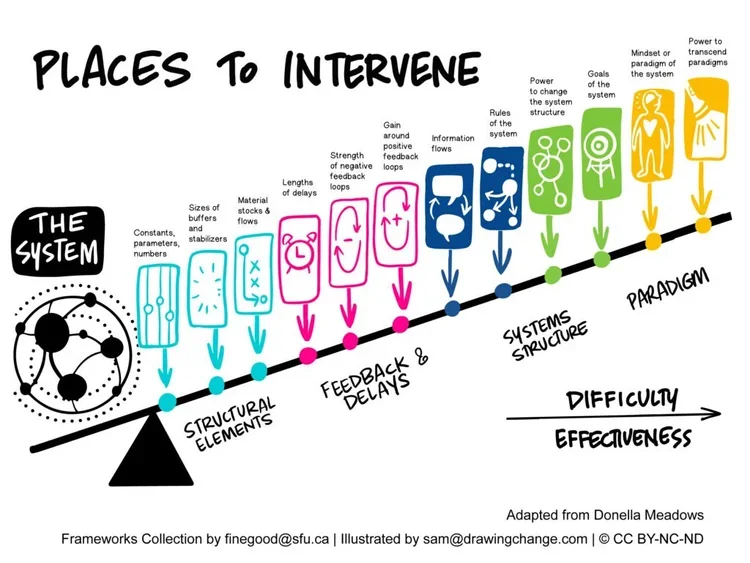
We are today looking at the rules of the system. What is possible, what is permissible, and, critically, what happens when you step outside the line.
Understanding them is not a technocratic detour. It is where system goals become tangible on the ground.
So if the previous instalments have been about what a participatory system should want, this one is about the small print that decides whether it is allowed to want it.
Thou shall not kill. Thou shall not steal. And thou shall not ignore the recommendations of a Citizen’s Assembly. Or something like that.
What today's rules are actually protecting
It takes roughly twenty-four hours and a small fee to bring a company into legal existence with full contracting rights, the ability to hold assets, and standing to sue.
It can take years of advocacy, political sponsorship, and ongoing budget fights to give a neighbourhood assembly any comparable status.
Inside most organisations, the asymmetry is just as stark, and encoded. A project can be initiated with a senior leader's verbal approval. A cross-functional team with genuine decision-making authority over how work gets done requires months of governance redesign, stakeholder buy-in, and a risk assessment.
That asymmetry is not accidental. It is the rule-layer of structural authorship. And it points in a consistent direction.
Pick up almost any rule cluster, whether in a democratic institution or a private organisation, and you find the same pattern underneath. The rules are not neutral. They are written to optimise for the system goal outlined in part 2. Everything else, including participation, is tolerated where it does not meaningfully disrupt that goal.
So when exploring who rules are there to protect there are a few patterns to keep an eye out for:
Who gets recognised as a legitimate decision-making body
The rules that govern how rules get written are most often controlled by actors whose interests are served by keeping that power concentrated. In democracies, constitutional procedures and electoral law are typically authored and revised by legislatures, which means political parties effectively write the rules that determine who can challenge their authority. This is the same for most executive boards across most organisational types.
2. What counts as a binding decision.
Most participatory processes are advisory by design, not because someone made a cynical choice, but because the legal architecture of decision-making draws a hard line between bodies with delegated authority and bodies with consultative status. Citizens' assemblies, community panels, staff forums, typically sit on the consultative side of that line. Their outputs can be ignored without legal consequence. The only cost is political or reputational, and those costs are optional.
Corporate law makes this particularly explicit. Fiduciary duties and shareholder primacy norms, embedded in statute and case law across most jurisdictions, define whose interests boards are legally required to serve. Workers and communities are stakeholders, not governors.
Even where leadership wants to treat them as co-equal decision-makers, the legal obligations of the organisation make it structurally difficult to do so. A board that privileges worker welfare or community benefit over shareholder return can be sued. A board that ignores a workers' council proposal faces no equivalent legal sanction.
3. How well entrenched a law or rule is
The rules that protect concentrated power are backed by thick layers of law, domestic and international, with real sanctions for breach. Investor protections, property rights, and contractual standing attract lawsuits, credit downgrades, and treaty disputes. Procurement rules and audit frameworks carry penalties for non-compliance. These are not cultural norms or management fads. They are enforceable obligations.
The rules that protect participatory gains, by contrast, typically rest on simple policy, pilot funding, or individual leadership commitment. A citizens' assembly can be discontinued after an election. A staff council can be dissolved in a restructure. Participatory budgeting can be defunded in a spending review. There is no legal barrier. There is no constitutional threshold.
Participation is tolerated where it does not disrupt the goal and protection is reserved for what serves it.
When rules make participation sensible
The point of tracing this architecture is not to produce despair. It is to locate where intervention would actually matter.
And the clearest pattern from the cases where participation has endured is this: institutionalisation matters more than enthusiasm. Political commitment without legal protection is temporary. Cultural change without structural embedding is fragile. When the rules do not change, participation lives or dies with the people who championed it.
One example, between 2015 and 2019, under Ahora Madrid, the city became a reference point for participatory innovation: participatory budgeting, citizen proposals, digital platforms for co-decision. The infrastructure was sophisticated. The commitment was genuine. But almost none of it was written into law or protected by statute. When Ahora Madrid lost the election, the new administration dismantled most of it within months. There was no legal barrier. Participation had been policy, not structure.
The counter-example is East Belgium. The German-speaking community embedded a permanent citizens' council into its constitutional framework in 2019. The council, selected by sortition and convening regularly, has formal agenda-setting power and a legislated relationship with the regional parliament. Governments can choose not to act on its recommendations, but they cannot abolish the council without constitutional change. Participation became infrastructure, not innovation.
German co-determination law remains the clearest organisational example. Worker representation is hardcoded into supervisory board structures by statute, for example, companies with over 2,000 employees require over 50% employee representation. Joint decision-making becomes a legal requirement rather than a managerial choice.
When the ownership structure itself distributes governance rights, participation is not a programme. It is the operating logic.
Especially where the higher leverage points around paradigms or systems goals are not established. We rely on laws and institutionalisation to embed longevity.
Participation that does not have a rule underneath it is always one leadership cycle away from disappearance.
What the rules of a participatory system would actually need to say
The structural conditions piece part 4 named five things that need to exist for participatory forms to emerge, scale, and persist. Rules are what give those conditions teeth.
Below are five specific rules a system optimised for self-governance would need to write. Offered as anchors for the argument and as prompts for finding their equivalents in your own context.
Rule 1: Creating a participatory decision-making body should be as straightforward as incorporating a business
The current asymmetry is stark. Commercial entities can be conjured into existence with a template and a fee. Democratic or participatory bodies require years of advocacy, political sponsorship, and legal exceptions. This is not neutral. It is a choice about which forms of collective organisation the system makes easy.
What could this look like?
A statute establishing "Registered Participatory Bodies" with a standard legal template, similar to how Companies House registers businesses. Any group meeting a defined threshold, whether 500 residents in a neighbourhood or 10% of employees in a business unit, can register with automatic rights to request information and submit proposals. This would sit in primary legislation: a Local Democracy Act for citizens' assemblies, or amendments to company law establishing employee governance circles with formal standing.
The legislative architecture already exists for commercial incorporation. Extending it to participatory forms is not radical, it is symmetrical.
Rule 2: Where participatory processes meet quality standards, their outputs must receive binding consideration
Most participatory processes are advisory by design. Their outputs can be ignored without legal consequence. The only cost is political or reputational, and those costs are optional. This is the interface problem. Recognition without a defined relationship to authorised decision-making is a gesture.
What could this look like?
An amendment to administrative procedure law specifying that where a participatory process meets defined criteria (sortition-based selection, minimum scale, facilitated deliberation, access to expert evidence, minimum duration), its recommendations must be tabled in the relevant decision-making body within 90 days. The authority must either implement, provide written justification for rejection published in the official record, or face judicial review for procedural failure. East Belgium's constitutional provision establishing the permanent citizens' council with formal agenda-setting power is the template.
Inside companies, this sits in shareholder agreements or governance manuals: where employee consultation processes meet defined quality thresholds, the board must respond formally within 30 days with implementation, reasoned rejection, or escalation to binding mediation.
"We'll take it on board" becomes a breach of governance procedure, not a polite closing remark.
Rule 3: Established participatory structures should be as difficult to dissolve as constitutional provisions
The rules that protect concentrated power are entrenched. The rules that protect participatory gains are not. A citizens' assembly can be discontinued after an election. A staff council can be dissolved in a restructure. There is no legal barrier.
What could this look like?
A constitutional amendment (requiring supermajority approval, typically two-thirds of the legislature plus ratification) establishing that once a participatory institution meets defined criteria for permanence, operating for two full cycles, demonstrated representativeness, documented influence, it can only be abolished through the same constitutional amendment process.
This mirrors the entrenchment given to independent electoral commissions or human rights bodies in many constitutions. In corporate law, this means writing participatory structures into articles of association, which in most jurisdictions require 75% shareholder approval to amend. Worker councils and employee representation bodies become part of the constitutional documents of the organisation. German co-determination law does this by statute: companies over a certain size must have worker representation by law, not by choice.
Rule 4: Time spent in participatory governance should carry the same legal protections as jury service
Participation is currently treated as volunteerism. People who take part do so in their own time, without statutory income replacement, childcare support, or job protection. This creates systematic exclusion. Time is a democratic asset. Treating it as a private resource means only those with flexible or secure employment can participate.
What could this look like?
Employment law amendment establishing that participation in registered participatory bodies is a protected civic duty. Employers cannot penalize employees for time spent in these roles, must provide paid leave equivalent to jury service, and face employment tribunal claims for retaliation. Public institutions running participatory processes must budget for income replacement, childcare, and accessibility support as mandatory line items, not discretionary spending.
Several jurisdictions already do this for jury service; the legislative template exists. The extension to participatory governance is mechanical, not conceptual.
Rule 5: The rules for changing participation rules must themselves be participatory
The goal is not to inscribe the right answer in stone but to build a system capable of writing better rules together over time. Some elements must be entrenched, minority protections and the binding force of participatory decisions, to function as guarantees. But the system must also retain adaptive capacity.
What could this look like?
A constitutional or statutory provision establishing that proposed amendments to participation frameworks must themselves go through a participatory process before adoption. Any change to the rules governing citizens' assemblies, participatory budgeting, worker councils, or governance structures must be reviewed by a sortition-selected panel before legislative or shareholder approval. This applies whether the change is proposed by a government, a board, or a reform coalition. The rules of the game are not the exclusive property of the people currently winning it.
This is the hardest rule to get right, because it balances rigidity with flexibility. But the principle is clear: participation must be self-sustaining, not dependent on continuous defence.
Embedding new structures doesn’t need extraordinary circumstances or visionary champions. They require clear pathways and ordinary support.
None of this is complicated in principle. The resistance is not intellectual, and it is worth being honest about that.
Rules that redistribute decision-making power are resisted by the actors whose current power depends on the existing rules. That is as true inside a company as it is inside a parliament.
Rules are made to be broken (or changed), including foundational ones, just they require more sustained pressure. This becomes more pressing and possible under conditions when existing arrangements have begun to lose their legitimacy. The question is not whether it is possible. The question is where to start.
So: where are the rules in your context silently selecting against participation? Not the attitudes, which are often genuinely sympathetic, but the rules. The compliance criteria. The legal statutes. The codes of conduct. The definitions of what counts as a valid decision and whose process is allowed to produce one.
What would it mean to change one of them so that deciding together stops being a special project, and starts being the assumption the system is built around?
The north star is still the same. The question from today is which bits of small print gets us there.
Next month, I’ll be delving into the next leverage point “Information Flows”, who does and does not have access to information. One that’s probably the most popular middle order leverage point.
These reflections are very much a work in progress, often emerging as they are written. They are offered as provocations rather than prescriptions. Challenge, critique, and invitations to build something better together are wholeheartedly welcome.
Would love to hear from you and if you know anyone who imagines a better, participatory future, please share!
Until then,
Ben
P.S.
If you want to read more about the work of Donella Meadows which inspires this series.
Buy the book - Thinking in Systems.
Or find a more concise summary of the leverage points from this article - Leverage points: places to intervene in the system