
Who Sees What: Information Flows and Why They Matter - part 5
This is reposted from our newsletter “Collaboration, Sorted - Monthly notes on shifting power and embedding participation and dialogue in democracy and organisations.”
To get these directly to your inbox you can sign up here - https://www.sortedcollaboration.com/newsletter
—
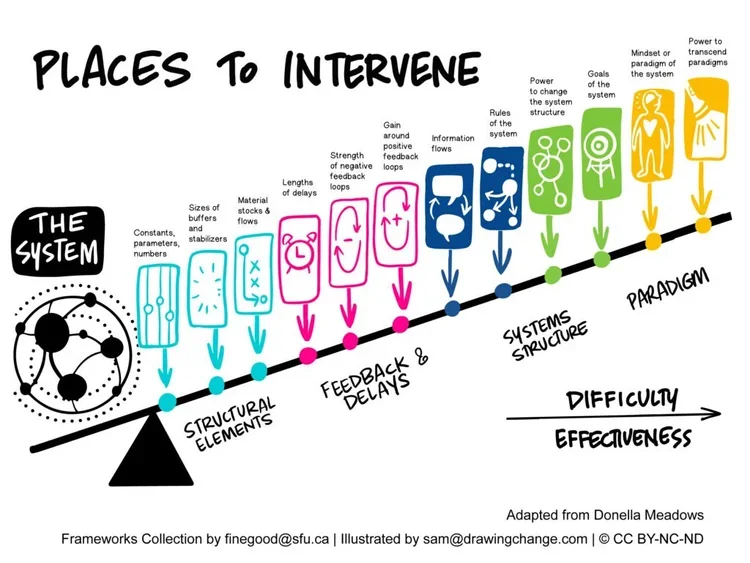
We're about halfway down the seesaw. Lower than paradigms. Lower than goals. Lower than rules. Into information flows.
There may be a sense that we are now tidying up around the edges of the real work. I want to push back on that, including my own previous framing of it. Lower leverage does not mean marginal. It means it struggles to do much without the higher-leverage shifts already in motion.
Think of the system we want to unlock as a jar with a very tight lid. The higher leverage work is the grip strength. Information flows are running the lid under warm water first. They do not open the jar alone, but without them even the strongest grip makes less progress than it should.
A participatory system that cannot see itself clearly will gradually lose the trust and engagement that makes participation viable at all.
This Is Not About the Media (Mostly)
There is a natural assumption, which I’d originally thought when working this over in my head. That information flows as a leverage point is primarily about media. Who controls the narrative. Which stories get told. Whose voices get amplified or buried.
That is not wrong. Media is an information flow. But this is about something more fundamental than journalism. It is about feedback loops. Whether information about the consequences of a decision travels back to the person who made it, in a form they can actually act on.
The media is one pipe. This leverage point is about the whole plumbing system, and more importantly, who gets to see the damp patch on the ceiling before the roof caves in.
-
Visibility is what turns information into a feedback loop. Without it, information exists in the system but cannot do its work. The media play a key role in creating visibility, but they are not the full story.
A whistleblower leaking internal data. A journalist publishing the findings. These are acts of visibility that can change behaviour. But they are episodic. They depend on someone deciding to look, and someone else deciding to publish.
They are more like someone occasionally checking for leaks than a system designed to show you the water pressure at all times.
Two stories to help illustrate how a visual feedback loop can change behaviour:
In a neighbourhood of identical houses, researchers discovered that half the homes had their electricity meter in the basement and the other half had theirs visible in the front hallway. Turns out the people who could see their meter used thirty percent less electricity. The information was always there. Making it visible was what opened the loop to a difference in behaviour.
In 1986, the American government introduced a simple rule. Any factory releasing hazardous pollutants had to publish its emissions publicly, every year. Within four years, pollution fell by forty percent. One company found itself on the Top Ten Worst Polluters list and cut its emissions by ninety percent. The consequence and behaviour shift did not come from a regulator. It came from the visibility itself.
Both stories turn on the same mechanism. Information that can be seen creates consequence. Information that cannot be seen, or that reaches the wrong person too late, does not.
Information flows in the current system
So using our previously established paradigms, we can sketch out how the most familiar information loops run.
The consumer loop runs like this: institutions broadcast options, people participate mainly as voters or survey respondents, and feedback is read as preference data rather than as shared reasoning. The information travels in one direction and is processed by the same people who generated the question.
The technocratic loop is adjacent: experts define problems, frame options, and filter relevant evidence, while lived experience enters late, if at all. Not because anyone has made a cynical choice to exclude it, but because the system was built around credentials and models, and public knowledge does not fit neatly into either.
And underneath both of these sits the stability loop: information about GDP, productivity, and market reaction dominates decision justification. Signals about trust, care, ecological limits, or the quality of democratic life are treated as background noise. They exist, somewhere, but they do not reach the people making decisions at a moment when those people might do something different.
Where signal goes to die
Think about how most organisations run consultations. Employees, residents, or citizens are asked for their views. Those views are collected, perhaps genuinely considered, and then a decision is made, often by the same people who were always going to make it. The information flows in, but it does not flow back. No one finds out what their input changed, if anything. No one knows if their voice landed.
That is not just bad practice. It is a broken feedback system. And broken feedback systems tend to unravel quietly until suddenly they do not. People stop turning up to meetings. Stop filling in surveys. Stop believing their participation means anything. Not because they do not care, but because the signal they sent disappeared into a void.
The advisory graveyard is one of the most reliably demobilising features of our current systems. Citizens' assemblies, staff forums, community panels: they generate rich, well-reasoned recommendations and then watch them pile up at the door of formal authority, technically received, effectively ignored.
The previous newsletter argued that rules are needed to give participatory processes binding consideration. Information flows are what make that rule legible and enforceable. You cannot hold anyone accountable for ignoring input that was never made visible in the first place.
Information only has power when it creates a genuine connection between action and consequence.
What a Participatory Information System Actually Needs
The structural conditions piece in this series argued that participation needs recognised legal forms, pathways to scale, and protection from reversal.
The rules piece argued that those forms need to be as difficult to dissolve as constitutional provisions, and that participatory processes with defined quality standards should receive binding consideration.
Information flows are the nervous system that makes all of that function. Without them, even well-designed participatory infrastructure makes decisions in the dark; and a structure that cannot see its own impact cannot defend itself from being quietly dismantled.
Here are five key considerations:
1. Decisions Need Traces
Every assembly, council, and institution that shapes public life should publish a simple, standardised record of how each significant decision was made: how the problem was framed, which evidence was used, what options were discarded, who decided, and how dissent was handled.
But a trace is only useful if it is readable. A dataset or technical report handed to a citizens' panel without interpretation is not useful. Accessible information and available information are not the same thing.
A decision trace is not bureaucratic overhead; it is the minimum condition for collective learning. Without it, the same mistakes repeat, the same voices get filtered out, and the same justifications get recycled without anyone being able to challenge them with evidence.
In practice: public bodies and organisations could start immediately, by requiring decision traces as internal policy before they are embedded in statute. What changes is not the legal framework but the assumption, from publishing that a decision was made to publishing how it was made, what it changed, and in a form that people outside the institution can actually interpret. This embeds trust and legitimacy to both the process and the outcomes it produces.
2. The Loop Needs to Close
Any decision that moves upward through the system, from neighbourhood to regional to national, should be pushed back down in plain-language summaries that include what changed because of local input. This sounds obvious. It rarely happens.
The rules piece argued that where participatory processes meet quality standards, their outputs must receive binding consideration: decision-makers must implement, provide a reasoned and public rejection, or escalate. That rule is only meaningful if the people who participated can see the response. Binding consideration without visible response is just a faster route to the advisory graveyard.
In practice: a procedural rule requiring public bodies to formally respond to participatory processes within a defined timeframe, with that response published in plain language and pushed back to the communities involved. Not a summary of the summary. The actual loop, closed. People need to know their signal landed, or they will stop sending signals.
3. Assemblies Need the Right to Pull Information
The first two points are about improving how information flows from institutions outward. This one is about reversing the direction. Participatory bodies, registered assemblies, worker councils, community panels, should have a collective right to request specific datasets, to demand impact reviews before large decisions are finalised, and to assign watchdog roles on specific policy areas. The capacity to trigger information flows, not just be subject to them, is where democratic power begins to become structural rather than performative.
The accessibility principle applies here too: data requested by an assembly should come with the context, narrative, and interpretive support needed to deliberate with it meaningfully.
In practice: extending freedom of information frameworks to include registered participatory bodies as collective requesters, with short statutory response times, clear refusal criteria, and an obligation to provide accessible summaries alongside raw data. In organisations, embedding equivalent rights in governance documents so that worker councils can request information relevant to decisions affecting members, before those decisions are made.
4. Building Knowledge That Survives the Rotation
Participatory systems are designed to rotate. That is one of their great strengths: no permanent power, no entrenchment, fresh perspectives brought into deliberation regularly. But rotation creates a structural amnesia. When assembly members leave, the knowledge they built through weeks of deliberation tends to leave with them.
This is a specific and solvable problem. The reasoning of one assembly needs to be available to the next: not just the conclusions, but the questions that were asked, the tensions that were not resolved, the minority positions that were held and why. A sustainable knowledge base is not an archive of minutes. It is a living record of collective reasoning, structured so that future participants can build on it rather than repeat it.
In practice: a requirement that participatory processes document not just outcomes but deliberative reasoning, in accessible form, as a condition of their recognised status. There is an opportunity to build a shared library of process, deliberation and outcomes, that exists across topic and jurisdiction.
Alongside this, investment in the facilitative and curatorial roles needed to maintain that knowledge, because a knowledge base that nobody tends does not stay useful for long.
5. The Civic Data Commons
All of the above depends on an infrastructure question that is easy to overlook: who owns the pipes? Pull rights, decision traces, proactive disclosure, and accessible knowledge bases are only as good as the data infrastructure underlying them. If that infrastructure is owned by private platforms, shaped by proprietary algorithms, or governed by actors whose interests diverge from those of the communities using it, the information flows can be shaped, filtered, or quietly withdrawn.
The civic data commons is the infrastructure answer to the participatory information question. Housing, energy, transport, public health, and the major platforms that mediate civic life should be required to treat operational data as part of a shared civic resource, governed by multi-stakeholder councils that include citizens. Algorithms that materially affect access to services or rights should be inspectable and subject to citizen oversight, with genuine power to require redesign.
This is not a proposal about open data in the abstract. It is about who governs the conditions under which information flows, and whether those conditions can be changed by the people the system is supposed to serve.
—
Connecting the Dots
There is an obvious objection to all of this. Traces, knowledge bases, proactive disclosures, data rights. These sound less like an invitation to participate and more like a compliance framework.
If the structural apparatus needed to protect participation makes participation feel like bureaucracy, something has gone badly wrong. The distinction that matters is where the obligation falls. Most of what is proposed here should land on the institution, not on the people participating. The meter in the hallway does not ask the homeowner to do any extra work, it just makes the consequence of their behaviour visible.
Regardless, it would be naive to pretend that better-designed pipes are sufficient on their own. A decision trace published by a system with no intention of changing is a well-formatted document that changes nothing. A closed feedback loop inside an institution that still treats participation as consultation will produce polite acknowledgements.
Information flows are warm water, not grip strength. The information asymmetries in our current systems are not oversights waiting to be corrected; they are features of a system organised to protect concentrated authority. Changing the information environment without also changing the goal, the structures, and the rules is the warm water running down the drain.
What information flows do is make the higher-leverage changes harder to quietly undo. A system that has to show its working is more difficult to dismantle. A participatory structure that can see its own impact is better placed to argue for its own survival.
So for anyone designing these possible futures - building the assemblies, writing the rules, creating the conditions - the information architecture is not an afterthought to sort out once the real work is done. It is part of what decides whether the real work persists.
—
Next month we move to the next leverage point down the seesaw: the gain around positive feedback loops. These are the self-reinforcing cycles. The loops that do not need pushing. Once running, they run themselves.
Think how wealth accumulates wealth, exclusion breed disengagement and authority protects authority.
The participatory question is which of the loops currently reinforcing concentrated power can be slowed, and which of the fragile generative ones such as trust building more trust and visible impact generating more engagement, can be amplified. It is a more tractable entry point than it sounds, and a more hopeful one than most.
These reflections are very much a work in progress, often emerging as they are written. They are offered as provocations rather than prescriptions. Challenge, critique, and invitations to build something better together are wholeheartedly welcome.
Would love to hear from you, and if you know anyone who imagines a better, participatory future, please share.
Until then,
Ben