
The Power of Positive Feedback Loops Thinking in Systems - Part 6
At 57 and recently retired, Sue assumed time spent meeting and making decisions had come to the end.
Then the random invitation to join the UK climate assembly arrived through the door. Within the year, she had completed the climate assembly and was sitting on the parish council.
"Who knows what's next," she said. "But it's definitely awakened me."
This is the potential positive feedback loop of participation.
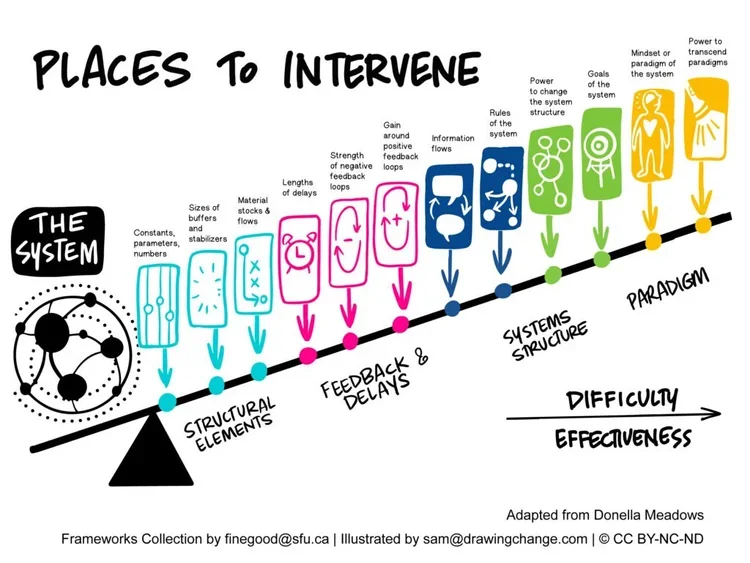
Positive feedback loops sit in the middle of Meadows' seesaw, below paradigms, goals, structural conditions, rules, and information flows.
Which is a good moment to clarify something about the leverage ladder. And that’s not just to maintain interest in a newsletter that could get less impactful with every issue.
Lower leverage does not mean less important. The distinction is more useful than that. The higher leverage points are where systemic change begins, but they are also where institutional power is most concentrated. Rewriting rules, resetting goals, shifting paradigms; these require access that most people do not hold.
The leverage points interact with each other; they do not simply rank. What sits lower on the seesaw tends to be more accessible, more actionable, and more available to everyone else. They have their own systemic contribution to make.
And the distinction between this leverage point and the ones above it matters even less. Positive feedback loops are the most mobile intervention in Meadows' framework; not the most powerful in isolation, but the most portable.
They do not require institutional permission to begin. They do not need a rule to change or a goal to reset. What they do is amplify; taking whatever progress has been made at the higher leverage points and compounding it, or in the absence of that progress, quietly building the conditions that make it thinkable.
Every paradigm that has ever shifted was preceded by people doing things that seemed, at the time, like small and peripheral experiments. It is only by looping into the power of positive feedback that becomes possible.
So what is a positive feedback loop?
It’s nothing to do with good intentions. Positive here means self-reinforcing. The more it runs, the more power it has to keep running. Wealth accumulates wealth. Exclusion breeds disengagement. Authority protects authority. These loops are already running in every political, organisational, and civic system; older, better-resourced, and with a significant head start.
The question this installment is concerned with is how the dominant loops can be interrupted, and which of the fragile generative ones can be deliberately seeded and amplified
The Matthew Effect
The counter-participatory loop predominant in our systems is all down to Matthew.
No, not an illuminati unmasking. It’s a label for the phenomena where small advantages lock systems into a specific and often unequal trajectory through self-reinforcing mechanisms. It’s name derives from the biblical gospel. It is also referred to as path dependence, or cumulative advantage. Although the name might be less familiar, the pattern it exerts in society will be immediately so.
Authority does not simply hold power. It accumulates it, through a mechanic that requires no bad intent from anyone involved.
The loop runs like this: authority attracts resources, because resources flow toward whoever controls decisions about their allocation. Resources buy access to agenda-setting, because the people who fund institutions have disproportionate influence over what those institutions consider worth addressing. Agenda-setting shapes the rules, because whoever frames the question largely determines the range of answers. And the rules protect authority, because the actors with the power to change rules are the same actors whose position depends on those rules remaining as they are.
The loop closes, and then runs again, slightly faster each time. The governance equivalent of compound interest, and nobody needs to intend it. Authority does not simply hold power. It accumulates it.
You can see it in democratic institutions where the same networks recirculate through positions of influence, not because they are uniquely talented but because prior access creates the conditions for further access. You can see it in organisations where the people who got promoted under a particular model of leadership are the ones deciding what good leadership looks like for everyone who comes after them.
The Sortition Solution
Regular readers will know I need little encouragement to talk about sortition. For the uninitiated: it is the practice of selecting participants randomly, stratified to reflect the population rather than the organised, the networked, or the already-convinced. It is how citizens' assemblies are composed, how ancient Athens chose its officeholders, and what I think we should be doing rather a lot more of.
The case for it here is narrower than usual. Sortition matters not primarily as a fairness mechanism, though it is that, but as a loop-breaking one. Random selection severs the compounding link between prior access and future access at the point of entry.
The mechanism is simple and the effect is structural. The people who reliably show up to shape outcomes are replaced by people who were not expecting to be there at all. That is not a guarantee of better decisions. But it is a guarantee that the loop which usually decides whose reasoning counts has nowhere to attach.
Rotation, random selection, and genuine openness to people without prior positional power are not gestures towards inclusion. They are interruptions to a path that otherwise runs itself.
The transformation the existing loops absorb
Something happens inside a well-designed deliberative process that rarely makes it into the final report. And nuturing it effectively is the missing link to shifting participation from a technocratic method to a design for power.
Relationships form between people who would never otherwise have been in a room together. Disagreement stops feeling like a threat and starts functioning like information. People arrive uncertain, sometimes sceptical, occasionally convinced they have nothing useful to contribute to a question that feels beyond them. They leave as something else; not converts, but people who have discovered a capability they did not know they had.
Anyone who has been in one of these rooms will recognise the dynamic. It is experientially different from a consultation, a focus group, or a town hall. Something shifts, and it is not just the policy ideas.
I have facilitated assemblies at community, national, and global scale, and the pattern is consistent. I am not exempt from it either. Facilitating assemblies on food systems had me scanning labels in supermarket aisles, trying to trace where things came from. Although it was only a couple of weeks before the Peruvian avocados crept back into the basket. Less a confession of hypocrisy than an illustration of the point.
Without structures that receive and reinforce what the process unlocks, the energy does not disappear. It gets absorbed. The existing loops are not waiting to be defeated; they are just exceptionally good at bringing everything else into it’s orbit.
In the absence of pathways into collective action, into ongoing deliberative structures, into roles that carry the method outward, energy goes where the existing culture already points. Sue bought an electric car. A community panel wrote a letter to their MP which was ignored. The assembly ends. And the loops that were running before continue running, largely undisturbed.
Which is exactly why the loops described in the next section need to be seeded deliberately, rather than left to chance.
Without structures that receive and reinforce what the process unlocks, the energy does not disappear. It gets absorbed.
The loops worth building on
Not all self-reinforcing loops serve the Matthew Effect. Good participation generates its own, quieter ones; fragile at first, easily absorbed if left unattended, but capable of compounding in the opposite direction if deliberately nurtured.
The question is which ones are inherent to the participatory experience itself, and what it would take to stop them dissipating before they can begin to challenge the gravitational pull of the existing system.
1. The Sue Effect: cumulative doing
The loop: participation produces a visible effect, something changes in the place or situation the participant cares about, and that visible effect makes the next round of participation more likely. The more it produces, the more it attracts. Efficacy is self-reinforcing. The first turn of the loop is often the hardest one.
The East Marsh Community Trust in Grimsby illustrates the mechanic as clearly as anything I have come across. It did not begin with a grand assembly or a carefully designed process. It began with litter picking.
People who had largely written off the prospect of anything changing in their neighbourhood did something small, saw the difference, and came back. What started as tidying a street developed, over years, into a community-led regeneration programme where they now own social housing in their community. A neighbourhood that has materially changed because the people in it kept participating. Each visible effect created the conditions for the next more substantial one. Start small, think big. The litter pick was not a compromise on ambition. It was how the loop got its first turn.
For all of us, the instinct this loop asks for is simple: find the next smallest credible thing and do it. Share what happened with someone else. The loop does not need a grand design to begin; it needs a first step visible enough that it might attract a second.
For practitioners and advocates, the responsibility is more specific. Design the follow-up as carefully as the assembly itself. The most important question at the end of any participatory process is not what did people decide, but what infrastructure exists to receive the energy that has been generated.
That means commissioning organisers and community animateurs alongside facilitators, not as an afterthought but as a core part of the design. It means building in small, structured opportunities for participants to act collectively after the process ends; a working group, a neighbourhood meeting, a shared communication channel, something that keeps the relationships alive and gives the energy somewhere to go.
And it means resisting the temptation to move straight to the next group before the last one has had a chance to compound. Not everyone who attended will carry the energy forward. But some will, and the practitioner's job is to make sure those people can find each other before the loop has a chance to stall.
2. From participant to protagonist
The loop: participation shapes how people understand themselves; not just what they did, but who they are. The shift is from I attended a process to I am the kind of person who does this. Once that identity is visible to others, it becomes socially contagious. Peers notice, and some of them begin to see participation as something people like them do.
The French Citizens' Convention on Climate is instructive. After the convention concluded in 2020, a significant number of the 150 randomly selected citizens formed Les 150, a civic movement that continued to campaign, advocate, and organise around the recommendations the government had begun to quietly shelve. People who had arrived as randomly selected members of the public left as political candidates, media figures and movement leaders; not because anyone planned it, but because the process had done something irreversible to how they understood themselves and what they believed they were capable of.
To seed it deliberately: the most powerful investment a practitioner or advocate can make is in the people the process has already changed. That means prioritising training and development of facilitators, organisers, and animateurs from within rather than importing them. When someone from the community is visibly leading the process, the implicit message to everyone else is: this is something people here do. That message travels further than any facilitated discussion, and it compounds in ways a one-off process cannot.
It also means nurturing the participants who show political energy after a process ends; connecting them to power holders, supporting them into formal roles, and treating their development as part of the work rather than a happy accident. The person who has felt the transformation themselves is a more credible advocate than any practitioner ever will be. That credibility is an asset worth investing in deliberately.
3. Compounding Legitimacy
The loop: as participation grows in scale and visibility, it generates both the pressure and the justification for formal systems to create new institutional pathways for it. More roles become available. More powers are granted. Participation stops being a project running alongside the system and starts becoming part of how the system works.
The Irish Citizens' Assembly illustrates what this looks like when the loop begins to run. What distinguished its most successful iterations was the deliberate decision to involve politicians in the process; not as decision-makers, but as observers and participants in the evidence-gathering. Politicians who watched citizens reason carefully through contested questions could not easily dismiss the outputs as uninformed or unrepresentative. The assembly created legitimacy that transferred into the formal system, and that legitimacy created space for future assemblies to be commissioned with broader mandates and stronger institutional connections. Each round generated pressure for the next.
To seed it deliberately: connect participatory processes to formal decision-making from the start, even modestly. Invite the people with institutional authority into the room as witnesses rather than chairs. Make the outputs impossible to quietly ignore.
This is also the loop most vulnerable to co-option. Institutional pathways can absorb the energy of growing participation without redistributing the power that makes it meaningful. A citizens' assembly with no binding relationship to decision-making, a staff forum with no authority over the decisions it advises on, a community board with no control over the resources it nominally governs; these are the loop running in reverse, generating the appearance of institutional change while the stability loop continues undisturbed underneath.
The test is not whether participation has been institutionalised. It is whether the institution that now contains it has actually changed its goal.
Keep going. It is already working.
The research on participatory budgeting, cooperative governance, and community self-organisation consistently points to the same three conditions: participants need to be able to answer yes to whether this mattered, whether they can see it, and whether it will happen again. When all three are reliably met, participation shifts from something people do on invitation to something people expect.
And it is happening. When I first got involved with the Sortition Foundation about ten years ago, it was a group of dreamers in a pub, hypothesising scenarios in which randomly selected citizens might one day have a meaningful role in consequential decisions. Those scenarios are no longer hypothetical.
Sortition has shifted from historical quirk to government commission. The question is no longer whether it works; it is how to generate enough institutional pressure to make it the norm. These loops have been running for years, quietly compounding, and it is worth sitting with that for a moment before moving on.
But compounding takes time, and these loops are still young. This is not a mature movement with established infrastructure. It is alive, it is growing, and it will not survive without tending.
Which is why the distinction between this leverage point and the ones above it matters less than it might appear. Loops built successfully at this level do not stay.
Participation that produces visible effects changes what people believe is possible. Identity shifts change what communities consider normal. Sustained institutional pressure changes what formal systems are willing to accommodate.
The work here is not separate from the higher-leverage shifts discussed earlier in this series. It is, over time, how those shifts become thinkable. Every rule cluster, every paradigm that has ever changed was preceded by people doing things that seemed, at the time, like small and peripheral experiments.
At the same time, generative loops are harder to sustain without the structural conditions, rules, and information flows this series has already covered. A loop that depends on visible effects cannot run inside an institution designed to make effects invisible.
This series has been building the case for changing those institutions precisely because the loops we want deserve better ground to run in.
Every time someone participates, sees something change, and carries that experience back into their network, the conditions for the next round shift. Not dramatically. But in the direction that makes it more likely, more meaningful, and harder to undo. The loops we build now are the upstream pressure on the rules, goals, and paradigms we want to shift. They are not waiting for that shift to happen first. They are how it happens.
But the loops do not wait for the ground to be perfect. Neither should we.
What compounds quietly today is what becomes unthinkable to reverse tomorrow.
Next month, we move to the next leverage point down the seesaw: negative feedback loops. Where positive loops are self-reinforcing, negative loops are self-correcting; the system's built-in mechanisms for keeping things within bounds.
A thermostat is a negative feedback loop. So is a market price signal. So, in theory, is a democratic election.
Until next time,
Ben