
The Power to Change the Systems Structure - Thinking in Systems Part 3
This is reposted from our newsletter “Collaboration, Sorted - Monthly notes on shifting power and embedding participation and dialogue in democracy and organisations.”
To get these directly to your inbox you can sign up here - https://www.sortedcollaboration.com/newsletter
——-
So far, we’ve established that the most effective ways to change a system is to shift the mental models it is built on, then reset goals that define it. Job Done.
For those unconvinced by the ease of that task. The good news is today, we’re tackling a lower leverage point. Where the balance towards easy implementation continues to shift. This is about having the power to change the system structure.
So, armed with a keyboard and a newly anointed three digits of subscribers. We proceed, charting our journey towards a future system built around participation.
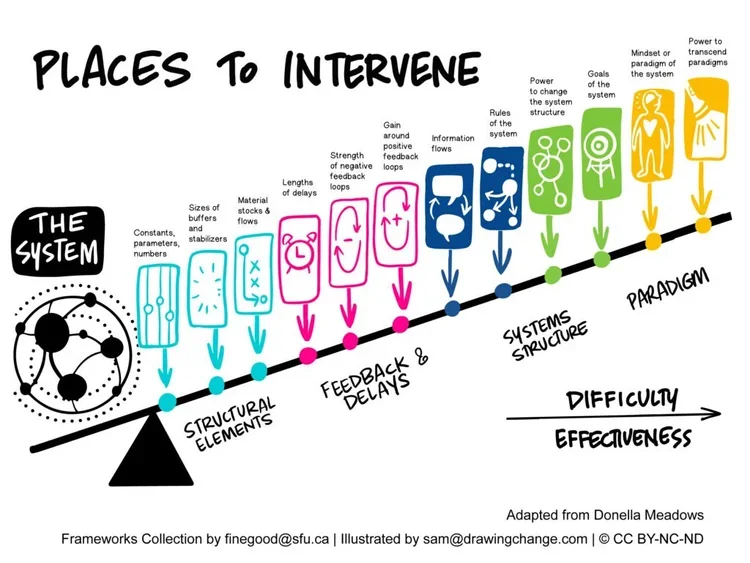
We set the goal in this imagined system in the previous newsletter, along the lines - to maximise the capacity for self-governance.
You can think of the goal as a plant on the window sill. Now it needs specific conditions - light, water - to allow it to grow. But without the right conditions in place, like many prophesised possibilities, it will wilt and die. This is what we’re focusing on today. The conditions that allow the goal to withstand.
It is at this point where new possibilities and imagined futures often stall. Most of us can adapt to existing systems, but we cannot easily author new ones.
The real constraint is not whether people are capable. It is whether one holds the power to add, change, evolve, or self-organise the structures we live inside.
It is not just how rules are enforced, but who gets to invent new rules when the old ones no longer serve.
The classical way to do this is to claim a divine right and do the king thing.
However, not only would this new system be as insecure as what preceded it. In a complex society, built on infinite interactions, it is nigh on impossible. Even in highly authoritarian societies, people exist and organise themselves independently, just under narrower and stricter conditions.
All living systems rely on self-organisation.
Self-organisation in this context isn’t the participatory parable, that all forms of social organisation should be decentralised and emergent. It is a biological fact. It is because living systems survive not through perfect control, but through their ability to restructure themselves when conditions shift.
The challenge is that this self-organising capacity to adapt is currently scarce and unevenly held, regardless of its intention. It is largely dependent on political goodwill or institutional exception rather than embedded in how systems routinely evolve.
If we cannot shift who holds the power to make processes durable, scalable, and self-renewing. It will always be vulnerable to reversal. That is true for liberal democracies, authoritarian regimes and participatory futures.
How structural power self organises today
The system already self-organises. Just selectively.
A multinational corporation can establish a new subsidiary in weeks. Register it and give it legal standing. That structure can then contract with governments, employ people, and reshape markets at scale.
A community group trying to establish a neighbourhood assembly with decision-making authority faces a different reality. No clear legal template, no automatic recognition, no pathways to durable funding or formal standing in governance. The effort required is exponentially higher for a fraction of the institutional weight.
The capacity to invent and institutionalise new organisational forms, or structural authorship, concentrates around capital and state power.
This is not accident. It is design. And it takes us back to the step above - setting the goal of the system
Most people can organise informally. They can protest, innovate locally, or exit systems they find intolerable. But their ability to turn new forms of organisation into durable, recognised, legally protected structures remains constrained.
This explains why the system evolves readily when change aligns with capital accumulation or administrative efficiency. And why it resists evolution that redistributes power, ownership, or purpose. Not because the latter is impossible, but because the right to structural invention is held unevenly.
We adapt to systems far more often than we author them.
From goals to conditions
In addition to our overall goal, we explored three supplementary goals in support of a participatory future. Adaptive collective capacity over efficiency. Distributed provisional judgement over insulated authority. Collective responsibility for shared goods over abstract growth.
These goals describe what a participatory system optimises for. But as we have covered, goals do not build the architecture. We also need the conditions that allow participatory structures to emerge, adapt, and endure.
This is where leadership matters differently. Not just in naming the goal, though that remains essential. But in actively creating the structural conditions that make new forms of organisation possible.
When a leader says the purpose of institutions is to help people govern together, the next question becomes immediate. What structures enable that? What legal frameworks? What resource flows? What forms of recognition and durability?
A participatory society is not defined by how often people are consulted. It is defined by whether ordinary people have standing to co-create and revise the structures that govern them.
So the practical question becomes: what conditions allow this capacity to become ordinary rather than exceptional?
The shift is from participation as episodic input to participation as a permanent capacity for collective self-organisation.
Five structural conditions for participatory self-organisation
These are not policies to pass or programmes to implement. They are conditions that organisations, governments, and other institutions can actively create. Design principles that expand the system's ability to reinvent itself from within.
1. Make it easy to create recognised collective forms
The condition: People can form assemblies, cooperatives, commons, and councils with the same legal recognition and institutional support currently reserved for corporations.
What this looks like in practice:
A city government creates a legal template for neighbourhood assemblies. Pre-approved with clear authority over specific decisions, like participatory budgeting allocations or local planning input. Formation requires only a basic threshold of resident participation, not years of advocacy.
A national legislature establishes first-class legal status for worker cooperatives and commons organisations. No requirement to mimic corporate governance structures. No penalty in access to capital, procurement, or regulatory treatment.
A philanthropic foundation shifts its funding model. Instead of requiring groups to fit pre-existing categories, it supports the legal and administrative infrastructure needed to make new organisational forms durable.
The principle is increasing structural diversity. When only a narrow range of organisational forms are legally viable and economically supported, the system's capacity to adapt is constrained. Making it easier to establish new forms expands what can be tried.
2. Build pathways from local invention to system-wide change
The condition: Successful participatory structures can scale and federate without losing their character or requiring capital to do so.
What this looks like in practice:
A regional government creates a federation framework for neighbourhood assemblies. Assemblies that work well can replicate their model. They can share learning, coordinate on issues that cross boundaries without needing to centralise or corporatise to gain influence.
A national health service establishes a process for local care innovations to become system policy. When a participatory care council develops an approach that works, there is a clear pathway for it to be tested elsewhere and, if successful, embedded into standard practice.
A professional body, say for teachers or social workers, creates mechanisms for practitioner-led innovations to shape training and standards. Not as suggestions to a centralised authority, but as contributions to an evolving commons of professional knowledge.
Without these pathways, self-organisation remains trapped at the margins. Inspiring but peripheral. A thousand beautiful experiments that never reshape the default.
3. Create non-capital routes to large-scale structural change
The condition: Communities can initiate and sustain large-scale projects without requiring private investment that brings governance capture.
What this looks like in practice:
A municipal government establishes a public-commons partnership model. Communities can propose significant infrastructure projects, affordable housing developments, or care services and. There is in built access to patient public capital which is maintained through community governance.
A national government creates cooperative development banks which are member-owned. They are capitalised to support cooperative federations at scale. Lending criteria based on member governance and social purpose, not just financial return.
International development institutions shift funding criteria. Instead of requiring projects to demonstrate commercial viability, they support models that demonstrate governance viability. Funding follows democratic legitimacy, not just market potential.
This redistributes evolutionary power, not just economic outcomes. It changes who can afford to try new forms of organisation and see them through to durability.
4. Make system evolution visible and contestable
The condition: How systems are changing is transparent and open to collective interpretation, not just available to those with privileged access.
What this looks like in practice:
A government department makes all policy development processes public by default. Not just final consultations, but the full record of how problems are framed, options are developed, and decisions are reached. They are structured so citizens can participate in interpretation, not just review.
A corporate sector regulator requires companies above a certain size to publish not just financial results, but governance data. It is clear who makes decision and how decision-making authority is distributed. As well as, what changes to organisational structure have occurred and why.
A city establishes a civic data commons. Information about how public services are performing, how resources are allocated, how the built environment is changing, all governed as a commons. With deliberative forums where citizens can collectively make sense of what the data means.
When evolution is visible, it can be learned from. When it is opaque, it can only be endured.
5. Protect diversity, rotation, and renewal
The condition: Authority does not calcify. Successful structures do not automatically consolidate. Variety is actively maintained.
What this looks like in practice:
A public institution embeds rotation into its governance. Board members, including executive leadership, serve defined terms with mandatory gaps before re-appointment. No permanent positions. No accumulation of structural power through tenure alone.
A funding body actively supports multiple approaches to the same challenge. Rather than identifying one 'best practice' and scaling it, it maintains a portfolio of different models. Treats diversity as a hedge against unknown future conditions.
A legislative body establishes review mechanisms that prevent consolidation. Regular assessment of whether successful organisational forms are crowding out alternatives. Active intervention to maintain variety when concentration threatens adaptability.
Evolution depends on variation. A system that collapses towards monoculture, even a participatory one, loses its capacity to learn. Protecting diversity is not a moral preference, it is functional necessity.
The role of leadership in creating conditions
Away from the pulpit pronunciations. This is where leadership matters most. Not in heroic vision or persuasive rhetoric, though both have their place. But in the practical work of creating conditions that allow new structures to emerge.
When a leader names a participatory goal, the harder work begins immediately. What legal frameworks need to change? What funding flows need to redirect? What forms of recognition and durability need to become available?
A city mayor who commits to participatory governance faces a choice. Continue running engagement exercises that extract input without redistributing authority. Or begin building the infrastructure, neighbourhood assemblies with real standing, participatory budgets with meaningful scope, that allows participation to become structural rather than performative.
A foundation director who believes in democratic innovation can fund projects. Or they can fund the legal infrastructure, model templates, administrative support, that makes it possible for hundreds of communities to establish recognised participatory structures without needing foundation support.
A civil service leader who wants adaptive institutions can commission reports. Or they can establish processes that allow innovations developed through co-production to become standard practice, without requiring every change to fight through centralised approval.
This is unglamorous work. It does not announce itself as transformation. It looks like legal reform, administrative procedure, funding criteria. But it is how systems gain the capacity to self-organise.
When these conditions are in place, or at least are emerging, participation stops feeling like a heroic anomaly.
Embedding new structures doesn’t need extraordinary circumstances or visionary champions. They require clear pathways and ordinary support.
Participation as collective evolution
This newsletter is not a blueprint for implementation. It is an invitation to notice where the power to self-organise sits in the systems we are part of. And to recognise that redistributing that power is not optional if we want participatory goals to become durable realities.
Societies have reinvented themselves repeatedly. Sometimes through revolution. Sometimes through slow accretion of practices that eventually became institutions. Always through a redistribution of who could imagine, design, and institutionalise new structures.
A system that concentrates the power to evolve will remain brittle. Innovation happens, but only when it aligns with existing centres of power. A system that shares that power becomes capable of growing into futures no one could design alone.
The work is not distant or abstract. It begins with organisations and governments choosing to create the conditions that make new structures possible. Legal frameworks that recognise diverse forms. Funding that flows to governance, not just growth. Transparency that allows collective learning. Protection for variation and renewal.
These are decisions within reach. Not easy. Not politically neutral. But tangible.
The north star is not a fixed point. It is how we keep from getting lost as we navigate together.
Where do you see these conditions emerging? Where are they blocked? What would it take to shift one of them in the systems you are part of?
Next month, I’ll be delving into the next leverage point “Setting the Rules of the System”, where the guiding hand becomes more explicit but less effective.
These reflections are very much a work in progress, often emerging as they are written. They are offered as provocations rather than prescriptions. Challenge, critique, and invitations to build something better together are wholeheartedly welcome.
Would love to hear from you and if you know anyone who imagines a better, participatory future, please share!
Until then,
Ben