
Negative Feedback Loops and the Problem with Thermostats Thinking in Systems - Part 7
This is reposted from our newsletter “Collaboration, Sorted - Monthly notes on shifting power and embedding participation and dialogue in democracy and organisations.”
To get these directly to your inbox you can sign up here - https://www.sortedcollaboration.com/newsletter
—
Over the cold winter months, I was feeling quite chuffed with my new heat pump thermostat. I set the temperature goal and the heating system did the rest. Comfortable stability assured.
The negative feedback loop, the corrective mechanism, did the job.
The problem is this loop only runs one way. So, with recent record high temperatures in London hitting mid-thirties for days. The system which could warm a cold room beautifully, could not cool a hot one. So I’m left with patchy workarounds and sleepless nights.
British homes can’t deal with hot weather because they were never designed to. The architecture is built for a different goal.
And that, roughly, is where we find ourselves with its democracy.
-
So far, this journey through the leverage points it has been about what can be transformed to tilt a system towards participation. New goals to name. New rules to write. New loops to seed and let run.
From here on, the work changes character. We have crossed onto the lower half of the seesaw, where the leverage on offer is not about redirecting the system but about keeping it on the course already set.
This is also, not coincidentally, where most of what passes for modern politics actually happens. The reshuffle. The policy tweak. The headline initiative that nudges a number by a percentage point. Adjustments to a thermostat in a house which was never properly insulated in the first place.
Which is, I think, the undercurrent running through this whole series and why so much of contemporary governance feels like motion without movement. In an era defined by seismic shifts, the only available lever is to adjust the dial.
—
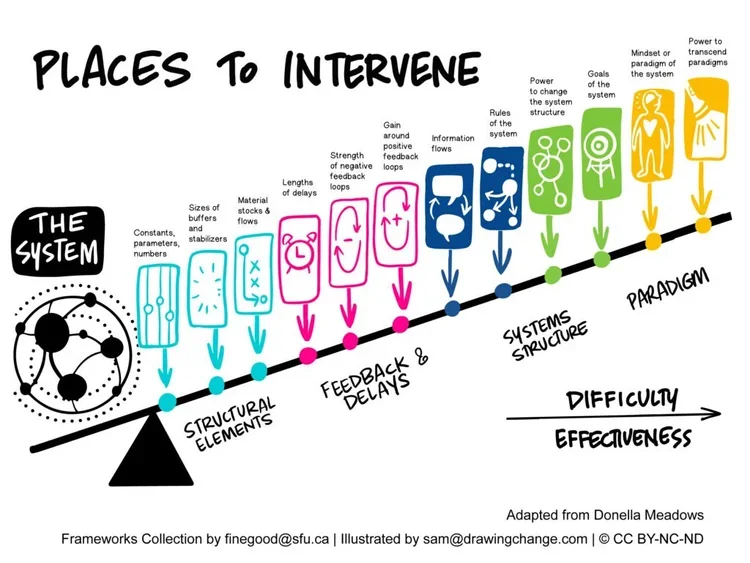
What is a negative feedback loop?
There is nothing inherently pessimistic about them. In systems terms, negative just means corrective.
A thermostat is the classic example, but there are many more familiar ones: hunger, a market price, and in theory, a democratic election. The system has a goal, measures reality against it, adjusts, and the loop closes.
The catch is that a negative feedback loop only knows how to serve the goal it was built for. Hunger is a brilliant corrective in a world of food scarcity. It is much less functional in a world of cheap calories and desk jobs. The mechanism has not changed. The conditions around it have.
Which brings us back to British homes and their one way architecture, built for cold winters and mild summers, and within those conditions doing the job well enough.
Democracy's loops were primed for stability in a world where politics was encountered every few years rather than through a phone in a pocket every few minutes.
This is not to say these loops are unimportant. They serves a purpose, it is just that the purpose is to work in tandem with an existing system, not to seed one.
For our purposes, that means the work here is diagnostic first. Why the current control mechanisms no longer fit the needs of the system they are meant to serve.
Four of them, in particular, are worth mapping out in more detail.
The Four Corrective Loops that shape the current economic and political order
1. Market price signals: the loop that actually works, and the wrong one to copy
Demand rises, the price rises, the higher price rations supply and tells producers to make more, supply expands, the price settles.
The loop is continuous, specific, and immediate. This is what a properly functioning negative feedback loop looks like, which is precisely why "run government like a business" sounds so plausible to so many.
The trouble is not that markets correct badly. It is that they only correct for something that can generate a price signal in the first place. A lifesaving medicine that is profitable only at a high price reaches the people who can pay for it. The people who need it most but cannot pay are invisible to the loop, because the mechanism has no way of registering them at all.
Climate change is the same failure at planetary scale. The cost of emissions lands on future generations and ecosystems, neither of which can bid, so the signal reads "all fine" while the system overheats.
This is the fallacy sitting underneath "run it like a business." A working market is evidence that negative loops can function well. It is not evidence that the same loop would function well for across all of society. Democracy exists precisely to make decisions about the things markets cannot price: public goods, intergenerational fairness, basic dignity, who gets heard when nobody is paying for the privilege.
Borrowing the market's responsiveness as a model for democratic health mistakes one well-built smart meter for the entire house.
2. Elections: the loop democracy is built around, and the one most overworked
The government does things. Citizens vote. Different government, different things. The loop closes, in theory every four or five years.
The trouble is one vote is being asked to carry far too much. Economic management, foreign policy, social policy, leadership competence, hundreds of specific positions, local concerns, values alignment, all compressed into a single binary choice between two or three options.
What survives that compression is barely more than a thumbs up or thumbs down on the entire experience of being governed. You cannot tell the system what specifically went wrong. You can only register that you are unhappy, and by the time you do, several years of decisions have already compounded past the point where that signal can do much correcting.
The lag was tolerable when governance moved at a pace a four-year cycle could plausibly track. It no longer does. A correction this infrequent, applied to a system moving this fast, is not regulation. It is a lurch and hope.
The inevitable consequence is that the incentive for government is to manage the appearance of competence rather than the reality of it. Which always explains why they are entirely beholden to the next signal.
3. Polling: a faster read that nobody is obliged to act on
Polling exists to compensate for the election's lag, a continuous read on opinion to fill the long silence between ballots. The trouble is that polling is more a temperature check not a considered judgement, which means the signal it produces is often noisier than the thing it claims to read.
Politicians who chase it end up overcorrecting in one direction, watching the public react against the overcorrection, then overcorrecting again, a feedback loop that degrades the relationship a little further each time it runs.
Petitions show the same pattern from the other end: hitting a hundred thousand signatures once felt consequential. It was once a functioning corrective mechanism where a threshold triggered a response.
It is now completely saturated. It reliably produces a templated reply and nothing else, and everyone involved knows it. Nothing obliges anyone to respond to what it reads.
4. Apathy: the signal the system blames you for sending
This is the one that should be the most obvious of the four, and the one the system is least equipped to hear. In the current architecture, the person who stops voting, stops answering surveys, stops turning up, is the apathetic one. The failure is theirs to own.
But apathy meets every condition of a negative feedback loop except the one that matters. A deviation occurs, a citizen tries the available channel and watches nothing change. A signal is sent, they stop participating. The only thing missing is a system on the other end capable of reading withdrawal as information rather than as the absence of it.
That misattribution is not a small error. If apathy is a character flaw, the fix is more civic education. If apathy is a signal, the fix is building somewhere for that signal to land before it curdles into withdrawal, which is a different and much harder bit to build.
A working thermostat does not blame the room for being cold. It treats the cold as information. Our democratic architecture is not currently plumbed to do the same.
In an era defined by seismic shifts, the only available lever is to adjust the dial.
What the picture actually shows
Run the four loops back together and a pattern holds across all of them. Governance has become faster, more layered, more contested. The signals it depends on are noisier, the drift between decision and consequence sharper.
The loops built to keep these systems on course are increasingly being asked to correct in directions they were never designed to register.
None of this is incompetence in the sense of nobody trying. Each loop is functional, just functional towards a single goal, stability, and largely blind to anything else.
The market signal stabilises price. The election stabilises the transfer of power. Polling stabilises the appearance of being heard. Even apathy, misread as it is, stabilises the system by removing the inconvenience of a citizen who keeps insisting something is wrong.
The trouble is that this single-mindedness has started to undermine the very goal it serves.
A market that cannot price the climate is not stabilising anything, it is exporting the cost of instability to people who are not yet born.
An election compressed into a four-year thumbs up or down is not stabilising governance, it is oscillating it.
A polling industry chasing noise produces governments that lurch rather than steer.
And a system that reads withdrawal as apathy rather than information loses the one signal that might have told it where the instability was actually building. Stability, pursued this narrowly, has started to sacrifice itself.
Which is the opening this series has been working towards. If the goal of these loops shifted from stability to participation, the same systems thinking lens that just diagnosed the failure can tell us what to build instead.
The loops built to keep us on course are increasingly being asked to correct in directions they were never designed to register
So what would a system with a different goal actually build?
If the underlying goal of the shifted from stability to participation, the architecture would change in three specific ways. It would be continuous rather than episodic. It would carry a structural requirement to respond, not just to receive. And it would route signals through deliberation rather than preference aggregation.
None of this is hypothetical. Each of the four loops already has a working, if early, counterpart somewhere in the world. The task is not invention. It is noticing what conditions let these counterparts survive, and then building more of those conditions on purpose.
1. The market signal gains company
The market still decides between options. Just people decide what options exist.
That is the shift. Not displacing the price mechanism, but fencing it. Let it allocate efficiently within a set of boundaries that someone, somewhere, has actually decided are acceptable, rather than treating whatever the market currently optimises for as the boundary itself. The parameters are the politics. The allocation is just maths.
Nest, the UK's largest workplace pension scheme, gives this some shape. Early in 2026 it convened a Member Assembly: fifty two members, randomly selected and stratified by age, income, pot size, and attitude to risk, given two weekends and access to independent experts to deliberate on a single question. How should Nest invest in members' best interests.
The recommendations landed on two themes. Invest for long term benefit, not just return. And give members a real voice in how that gets decided, not a one off. Nest committed to publishing a full written response to each recommendation, rather than filing the report and moving on.
Sixty billion pounds of other people's retirement money is still allocated through markets. What changed is who got a say in what those markets are allowed to do with it, before the price signal took over.
Nothing exotic made this possible. A trustee body with a statutory duty to act in members' interests. A chief executive willing to call it deliberation rather than a focus group. A team brought in to design the process properly rather than dress up a token consultation. Scale that logic to sovereign wealth funds, planning authorities, strategic investments portfolios and the same shift repeats.
2. Polling that surfaces solutions
The fix for polling is not a better instrument for taking the same kind of reading. A more frequent poll, a bigger sample, a sharper algorithm sorting the noise, all of that still asks people to register a position rather than work one out.
What changes the picture is depth. Giving people the tools to consider the evidence and to arrive at a view rather than report one they already held. And depth, done at scale, produces something a poll structurally cannot. Not just what people think, but where the tradeoffs actually sit. Which parts of a position hold under pressure and which move once people understand the cost of the alternative.
Camden Council's trial of Demos's Waves project is a useful sketch of what that looks like in practice. Rather than polling residents on social care priorities, it put a simple open question to people, gathered ideas at scale, then moved a smaller group into sustained deliberation to turn those ideas into proposals the wider group could respond to. What came out the other end was not a number but a structure. Where people agreed easily, where they only agreed once a tradeoff was made visible, and where no amount of further discussion was likely to shift the line.
Pol.is, used in projects from Taiwan to a county planning process in Kentucky, works on a similar premise at a different scale. People do not vote on a question, they write statements and see where agreement actually sits across a divided group, refining their thinking against views they would otherwise never encounter. The map that produces is not of opinion. It is of where the tradeoffs are, who feels them, and how much movement is genuinely available.
Imagine that running continuously, across services and policy areas, rather than as a one off exercise wheeled out when a decision needs legitimising. Each instance on its own is a detailed picture of one tradeoff. Brought together, the picture compounds.
A government, or a pension fund, or a council, stops asking what people think and starts holding a live, interactive model of what people are actually willing to trade against what. That is the version worth building towards. Not faster polling. Genuine intelligence about where the possibility is.
3. The Trigger Has to Be Wired In, Not Waited For
A tool that can finally see where the tradeoffs sit only does half the job if someone still has to decide whether to act on what it finds. That decision is the gap a consultation has always left open.
The fix is to make response automatic once a threshold is met, not discretionary. A few shapes this could take:
A planning application that crosses a calibrated disagreement threshold, detected through the kind of tools described above, triggers a citizens' panel automatically, the way a project above a certain size automatically triggers an environmental impact assessment. Nobody has to decide it matters. Size decided that already.
A government policy that shows sustained, structured disagreement across a Pol.is style process triggers a binding deliberative process to resolve the very tension it highlights
In each case the trigger sits inside the body with the power to act, and that body has a defined obligation to respond in public.
This is the difference between deliberation as decoration and deliberation as governance.
A panel with no statutory link to a decision making body is a well-run conversation the system is free to set aside.
A panel wired into the mechanism that produces the outcome is something else. Deliberation the architecture cannot route around.
4. Apathy Becomes a Signal the Architecture Is Built to Read
Withdrawal stops being something the system blames the citizen for and becomes something the system is designed to notice early, while it is still cheap to respond to.
Falling turnout, a citizens' panel that struggles to recruit, an assembly invitation nobody returns: each becomes a deliberative question rather than a closed file. Who is disengaging, why, with that reasoning surfaced and connected to a visible institutional response, rather than logged as a recruitment shortfall and moved past.
A citizens' assembly invitation typically gets a response rate somewhere between three and ten per cent, in the same broad range as a modern poll. The Sortition Foundation's own recruitment data shows that response runs consistently lower in poorer neighbourhoods than in more affluent ones. Their working explanation is not that people there care less. It is that people there have learned, from a long enough run of being asked and then ignored, that responding rarely changes anything.
The withdrawal is not apathy. It is an accurate read of a system that has not, until now, had any of the three previous mechanisms in place to prove otherwise.
Putting the first three points to work against a single neighbourhood's response rate is itself a test of whether they hold. Detect the disagreement underneath the silence rather than just its absence. Trigger automatically rather than wait for someone to notice the numbers are bad. Respond in public, including to the people who never showed up, not just the ones who did.
Read this way, apathy is not the leverage point's hardest problem. It is the one all three of the others were built to answer.
The task is not invention. It is noticing what conditions let these counterparts survive, and then building more of those conditions on purpose.
Bringing it all together
Run the four back together and the architecture comes into view. A market with deliberative input on how it can best decide. A polling apparatus that gives up the comfort of a single number for the harder, more honest picture of where people actually move. A trigger that fires on its own rather than waiting to be felt as urgent by whoever happens to be in the room. And apathy, finally read correctly: not the public giving up on participation, but participation giving the public every reason to.
None of these four are speculative. The future this issue has been describing is not a design brief. It is a pattern already running in scattered, underfunded, often accidental form, waiting for someone to notice it is a pattern and build the conditions that let it spread.The four corrective loops we inherited, the market signal, the election, the poll, the shrug of disengagement, were built for a world with slower problems and a public asked to do less.
They have not failed through neglect. They are working exactly as designed, and the design has run out of road. What replaces them is not a better version of the same mechanism. It is a different relationship between sensing and acting.
A thermostat that can finally feel the room still does nothing until someone wires it to the AC.
—-
What compounds quietly today is what becomes unthinkable to reverse tomorrow.